

Vadzo Imaging Launches Color USB 3.2 Gen1 UVC Camera with Onsemi AR0235 HyperLux™ SG Global Shutter Sensor
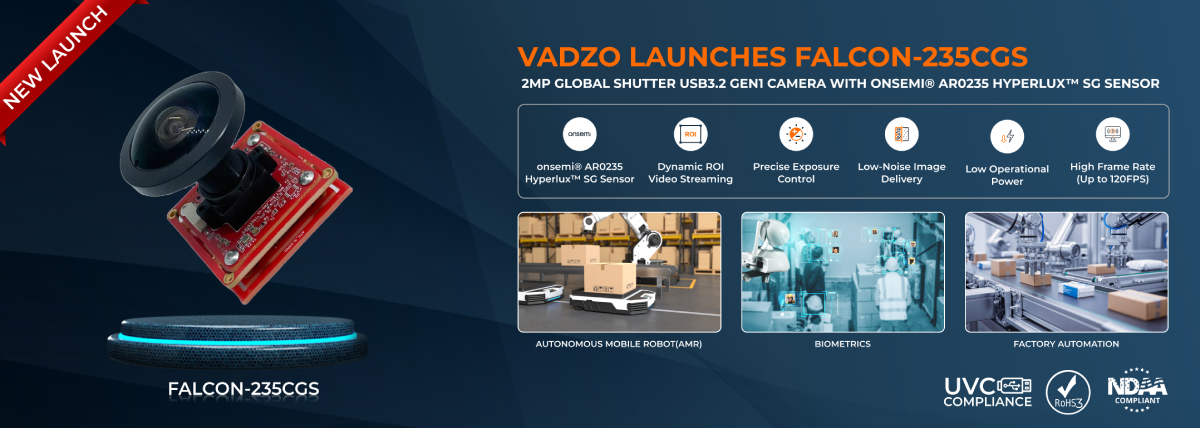
Vadzo Imaging Launches Falcon-235CGS
AR0235 HyperLux™ SG | Global Shutter | Upto 120 fps | Onboard ISP | Dynamic ROI | ROI-Based Auto Exposure | NIR Capable | VISPA ARC SDK | NDAA Compliant
TEL AVIV, ISRAEL, May 27, 2026 /EINPresswire.com/ -- Vadzo Imaging, a global embedded vision solutions leader, is proud to announce the launch of its new product: the Falcon-235CGS Color USB UVC Camera, a compact and power-efficient 2.3MP USB 3.2 Gen 1 UVC global shutter camera designed for embedded vision applications. Built on Onsemi's AR0235 HyperLux™ SG image sensor, the Falcon-235CGS delivers low-noise, artefact-free motion capture with low power consumption for motion-critical applications including robotics, industrial inspection, and automated imaging systems.
Key Features of the Falcon-235CGS AR0235 HyperLux Color USB3.2 Gen1 UVC Camera:
Global Shutter Imaging with the Onsemi AR0235 HyperLux™ SG Sensor : The Falcon-235CGS is based on the Onsemi AR0235 HyperLux™ SG global shutter CMOS image sensor, providing a 2.3MP resolution with an active pixel array of 1920 × 1200 and supporting frame rates of up to 120 fps at full resolution. The global shutter architecture enables simultaneous exposure of all pixels, making the sensor suitable for applications involving object movement where rolling shutter effects are undesirable. The sensor also supports imaging in near-infrared (NIR) wavelengths, enabling operation under IR illumination.
Deterministic Exposure Control and Sensor-Level Features : The Falcon-235CGS, AR0235 USB camera leverages Vadzo's Falcon USB architecture to expose the imaging capabilities of the Onsemi AR0235 sensor while maintaining deterministic video streaming with low latency and minimal processing load on the host system. The AR0235 integrates a 5 × 5 statistics engine to support region-of-interest-based auto-exposure, along with Automatic Black Level Calibration (ABLC), pixel binning, windowed readout modes, and row and column skip functions. These capabilities allow flexible trade-offs between resolution, frame rate, noise performance, and power consumption for continuous-operation embedded vision systems. Sensor features such as external trigger synchronization and on-chip flash control are supported through Vadzo's integrated imaging pipeline firmware.
Integrated ISP for Color Image Processing : The Falcon-235CGS, AR0235 camera integrates an on-board Image Signal Processor (ISP) that implements the full color imaging pipeline required for production deployments, offloading image processing from the host CPU and GPU and allowing system resources to be allocated to core applications. The ISP performs functions such as demosaicing, color correction, white balance, exposure control, noise reduction, and image enhancement, reducing dependence on host-side processing. This architecture enables consistent image output across operating systems, improves effective frame rates, reduces glass-to-glass latency compared to host-based ISP implementations, and simplifies integration for USB-based embedded vision platforms. ISP features are accessible through standard UVC controls as well as Vadzo's VISPA SDK.
UVC-Compliant USB 3.2 Gen 1 Interface : The Falcon-235CGS is a global shutter USB 3.2 Gen 1 camera compliant with the USB Video Class (UVC) standard, enabling plug-and-play video streaming on Windows, Linux, and Android operating systems using native UVC drivers. The USB 3.2 Gen 1 interface in combination with UVC provides sufficient bandwidth for high-frame-rate global shutter imaging while maintaining low and predictable transport latency, allowing rapid evaluation and deployment without the need for custom driver development. In addition to standard UVC functionality, the Falcon-235CGS exposes extended imaging, synchronization, and sensor controls through Vadzo's VISPA software toolkit.
NDAA Compliant USB Camera Design : The Falcon-235CGS, AR0235 USB Camera is designed using NDAA-compliant components and architecture, enabling eligibility for procurement in government, public-sector, and regulated enterprise deployments. This simplifies compliance requirements for OEMs and system integrators developing embedded vision solutions for NDAA-restricted environments.
VISPA ARC SDK for Falcon-235CGS - AR0235 USB3.2 Gen1 UVC Camera
The Falcon-235CGS, combined with Vadzo's VISPA ARC SDK, offers developers extremely advanced functionality regarding camera control, which goes far beyond conventional UVC capabilities. VISPA ARC SDK is Vadzo's software solution for setup, video streaming, and low-level control of any Falcon USB camera model. Through providing direct access to the capabilities of the Onsemi AR0235 global shutter sensor via USB connectivity, the VISPA ARC SDK ensures deterministic control over images while keeping the host complexity low. This makes the software development kit suitable for edge applications. The main capabilities of the VISPA ARC SDK for Falcon-235CGS are:
Dynamic ROI setup for application-driven FOV optimization
ROI-based Auto Exposure for consistent imaging in local areas
Precise exposure and gain control for motion-critical scenes
Trigger and Flash Controls to Synchronize Image Capture
Sensor settings access, binning, windowing, and frame timing
Firmware setup and management
The VISPA ARC SDK provides APIs for C, C++, C#, and Python programming languages to seamlessly integrate it with different embedded environments. This helps developers as well as manufacturers to quickly develop their product with better control over the low-level details of embedded vision applications.
Target Application Areas
The Falcon-235CGS AR0235 USB camera is particularly suited for embedded vision solutions where global shutter capability is desired, and deterministic USB connectivity and low host-side processing are necessary. The applications would include:
Autonomous Mobile Robots and AGVs: Autonomous mobile robots operating in warehouse and factory environments encounter variable ambient lighting, reflective floor markings, and mixed fluorescent and LED zones that create exposure instability in standard cameras. More critically, at the translation speeds typical of AMR navigation — even moderate velocities above 0.3 m/s — rolling shutter sensors introduce barcode and QR code skew that increases decode failure rates and forces slower survey speeds. The Falcon-235CGS, ARO235 Global Shutter Camera captures the full frame simultaneously, eliminating motion distortion on navigation markers, obstacle features, and conveyor labels regardless of robot speed. ROI-based auto exposure allows the camera to meter against a defined region — a floor marker, a shelf label — rather than averaging against a variable background, stabilizing exposure across lighting zone transitions without manual reconfiguration. USB-powered operation and the compact 38 × 38mm form factor simplify direct integration onto AGV and AMR chassis without dedicated power routing.
Barcode and ID Scanning Systems: Distortion-free label capture is the fundamental requirement of any scanning system, and rolling shutter sensors fail it whenever labels are moving relative to the camera. At typical conveyor label speeds, the diagonal skew introduced by a rolling shutter is sufficient to reduce 1D barcode decode rates from near-100% to below 80%, with further degradation at higher densities. The Falcon-235CGS, ARO235 Global Shutter Camera eliminates this failure mode entirely. Dynamic ROI streaming allows the active capture region to be narrowed to the label zone, increasing effective frame rate within the USB bandwidth budget and reducing host-side decode latency. NIR sensitivity supports operation under 850 nm illumination commonly used in industrial scanning environments to provide flicker-free, ambient-independent lighting. The combination of global shutter, dynamic ROI, and NIR capability makes the Falcon-235CGS a direct fit for both fixed-position tunnel scanners and handheld decode devices.
3D Scanning and Structured-Light Measurement: Structured-light 3D reconstruction requires the camera to capture projected fringe or pattern illumination at precise, externally triggered moments. Rolling shutter sensors introduce inter-row timing offsets that corrupt fringe phase data and reduce reconstruction accuracy, particularly at the frame edges. The Falcon-235CGS, AR0235 camera supports hardware trigger input and on-chip flash control through its GPIO connector, allowing the camera to synchronize frame capture to pattern projection events with low and deterministic latency. Global shutter eliminates row-level timing offsets entirely, preserving fringe phase uniformity across the full frame. At up to 120 fps, high-speed pattern sequences can be projected and captured within short acquisition windows, supporting both static and slow-motion subject measurement in the same hardware platform.
Biometric and Identity Capture Devices: Biometric capture — facial recognition, iris scanning, feature-based identity verification — requires consistent image geometry and stable exposure across the capture event, regardless of subject motion. Rolling shutter sensors produce facial geometry distortion during subject movement, increasing false non-match rates in face recognition systems and degrading iris feature extraction quality. The Falcon-235CGS global shutter captures face and iris regions with geometrically accurate, distortion-free frames even when subjects are in motion. NIR capability supports active IR illumination for controlled, ambient-independent face capture in kiosks, access control systems, and identity terminals. Onboard ISP processing delivers consistent color balance and noise reduction without host-side variation across operating systems, simplifying compliance testing and certification for biometric device deployments.
Embedded Edge Vision Nodes: Always-on embedded vision deployments in smart city infrastructure, retail analytics, and industrial monitoring share a common constraint: the host platform has limited processing headroom, and the vision system must deliver usable image data at low CPU cost on a continuous basis. The Falcon-235CGS is designed precisely for this environment. Onboard ISP processing delivers a fully processed image stream to the host without GPU or CPU involvement in the imaging pipeline. USB-powered operation via a single cable eliminates separate power infrastructure. The operating temperature range of -40°C to 85°C supports outdoor and thermally demanding deployments. At 13 grams without lens, the camera imposes minimal payload on compact edge platforms, drones, and handheld devices. Dynamic ROI streaming reduces data throughput when only a subsection of the scene requires analysis, further lowering host processing load in continuous operation.
Frequently Asked Questions
What is Dynamic ROI streaming, and what practical advantage does it offer?
Dynamic ROI streaming lets you define a specific subsection of the sensor's active array to capture and transmit, rather than the full 1920 × 1200 frame. By streaming only the area of interest, you can achieve higher effective frame rates within the USB 3.2 Gen 1 bandwidth envelope, reduce data processing load on the host, and focus exposure control on the exact region that matters for your application. For barcode scanning, where the label occupies a narrow band of the frame, ROI streaming can dramatically improve throughput. The Falcon-235CGS exposes dynamic ROI configuration at runtime through the VISPA ARC SDK, allowing application-side adjustment without firmware changes.
What does UVC compliance actually mean for deployment, and where does it fall short without the VISPA ARC SDK?
UVC compliance means the Falcon-235CGS is recognized as a standard video device by Windows, Linux, and Android without any driver installation. Any application that can open a webcam — OpenCV, GStreamer, custom capture tools — can stream from it out of the box. However, standard UVC only exposes a limited control set. Sensor-level capabilities like dynamic ROI, binning, frame timing, pixel windowing, hardware trigger, and flash control are outside the UVC specification. The VISPA ARC SDK extends access to these features over the same USB connection without changing the UVC streaming interface. For production deployments requiring fine-grained control, the SDK is the necessary complement to the standard UVC interface.
What distinguishes the Falcon-235CGS from the AR0234-based cameras in Vadzo's lineup, and when should one be chosen over the other?
Both the AR0235 and AR0234 are Onsemi global shutter sensors in a similar resolution class. The AR0235 HyperLux™ SG in the Falcon-235CGS is a newer-generation sensor with improved noise characteristics, updated pixel architecture, and the HyperLux branding that indicates enhanced low-light and dynamic performance relative to the previous generation. The AR0234-based cameras remain a cost-effective choice for applications where the AR0234's specifications are sufficient. The Falcon-235CGS is the appropriate selection when improved image quality under challenging lighting, reduced noise at higher frame rates, or access to the full AR0235 feature set — including its 5×5 statistics engine for regional AE — are required by the application.
Is there a minimum order quantity, and what customization options are available for volume OEM deployments?
There is no minimum order quantity — the Falcon-235CGS can be purchased in any quantity, from single evaluation units to production volumes, through the Vadzo online store. For OEM deployments, Vadzo offers a range of hardware and firmware customization services including form factor and board redesign, custom firmware features, NIR and color LED array integration, ToF/IMU sensor integration, electro-mechanical lens filter control, and IP-rated enclosure design. Evaluation units are available for customization requirements or bulk pricing, contact Vadzo at vadzoimaging.com/contact-us.
Availability
The Falcon-235CGS is available for order. Specifications, datasheet downloads, and evaluation unit requests are available at www.vadzoimaging.com.
About Vadzo Imaging
Vadzo Imaging designs and manufactures embedded and machine vision cameras for OEMs and system integrators. The company offers imaging platforms across USB, MIPI, GigE, and SerDes interfaces, with in-house development across sensor selection, optics, ISP tuning, firmware, and interface stacks, including UVC, Meridian (in-house ONVIF stack), and Vortex (in-house RTSP stack). Vadzo supports edge AI integration and provides OEM customization across hardware, firmware, and software for applications in industrial automation, robotics, smart surveillance, and life sciences.
Alwin Vincent
Vadzo Imaging
+1 817-678-2139
alwin@vadzoimaging.com
Visit us on social media:
LinkedIn
YouTube
X
Legal Disclaimer:
EIN Presswire provides this news content "as is" without warranty of any kind. We do not accept any responsibility or liability for the accuracy, content, images, videos, licenses, completeness, legality, or reliability of the information contained in this article. If you have any complaints or copyright issues related to this article, kindly contact the author above.
